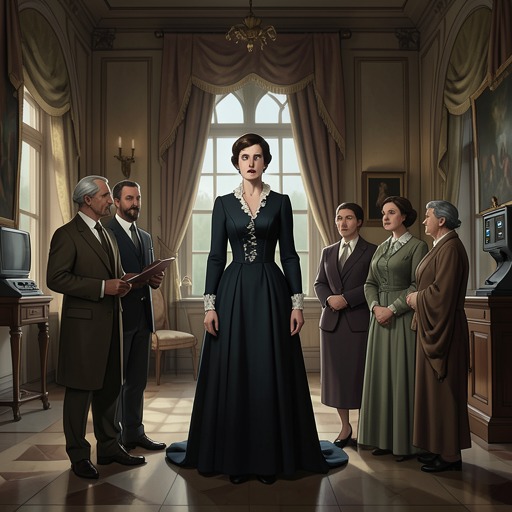
Rowan's near-fatal confrontation with Mona
Blood CanticleRowan’s near-fatal confrontation with Mona is a turning point in the cousins’ relationship: during a visit to Mona in the hospital, Rowan nearly uses her power to kill her, then stops when Mona makes clear that she is afraid. Mona’s eventual escape and decision to seek Quinn rather than accept help from Rowan give the episode consequences beyond the immediate danger. Recalled later through Rowan’s admission and Mona’s account, the incident links a moment of family crisis to the larger story of illness, secrecy, and the limits of medical and supernatural power.
Causes and circumstances
At the time of the confrontation, Mona was gravely ill after years of deterioration. Lestat describes her as under seventy pounds and in severe pain; her sickness had followed a traumatic birth, though he admits he did not understand its cause. Her long decline had narrowed her life to the prospect of dying, and she later recalls that death had become its central obligation. She had learned to think about how to make her decline easier for the people around her, even as ordinary pleasures such as music and food became harder to bear.
Rowan’s visit took place against the pressure of that prolonged illness and the family history surrounding it. Mona remembers that Rowan possessed a power she could not explain, and she could not determine whether Rowan was acting for her own sake or for Mona’s. What mattered in the moment was that Rowan seemed capable of killing her. The danger was therefore not an abstract family fear: Mona understood it as an immediate threat and told Rowan to stop because she was frightening her.
The confrontation and Mona’s escape
Mona later recounts the encounter to Lestat. She remembers telling Rowan that she was scared and asking her to stop; Rowan then burst into tears, although Mona is uncertain whether she or Rowan began crying first. The uncertainty in that recollection does not lessen the event’s central fact: Mona recognized the danger, and Rowan did not carry out the attack. Lestat later confirms that Rowan had the power to kill her but refrained once she understood that Mona knew what was happening.
Mona escaped after the confrontation. When Lestat asks whether she got away, she confirms that she did, indeed. Her account places the escape within a life marked by repeated threats to her survival: she had already been sick for years, had lost her child, and was living with the belief that she was supposed to die. Rowan’s near-attack becomes another rupture in that history, but it is also a moment when Mona asserts fear and Rowan’s intended action is interrupted.
Rowan’s confession and the aftermath
The episode returns later as Rowan speaks with Lestat. His account of her distress calls up the hospital room and Mona sobbing while Rowan stood at the doorway; he recognizes the confrontation as the moment when Rowan almost used her power and almost killed Mona. Rowan confirms the essential point: she had frightened Mona, who knew what Rowan meant to do and knew that she had the power to do it. Rowan says the act could have appeared on an autopsy as a stroke, but Mona understood the threat before it could be hidden behind a medical explanation.
Lestat answers that it had not been the right time and that Mona wanted to go to Quinn. His response connects the near-fatal encounter to the immediate circumstances of Mona’s survival: she had been suffering, and her own choice was to seek Quinn. Later, when Mona asks to go past the Mayfair house on First and Chestnut, Lestat refuses because Rowan might sense her nearby. The refusal shows that the confrontation still shapes what the others consider safe; Mona’s survival has not erased the danger or restored an uncomplicated relationship between the cousins.
Illness, care, and authority
The incident sits within a wider contrast between Rowan’s professional identity and her personal crisis. Michael describes her work at Mayfair Medical as a complete vocation but also an escape: she works to exhaustion, while her public persona has become the only one she can sustain. He points to the institution and its demands, including a new hospital wing, the Brain Study Program, and research projects dependent on Rowan’s energy. His account offers context for her distress without establishing that work caused the near-attack.
Mona’s illness also makes the scene a question of agency in care. Years of treatment and pain had left her with little expectation beyond death, yet at the decisive moment she could express fear and refuse Rowan’s approach. Later, when Lestat offers her the Dark Blood, he tells her that she has a choice; Mona reaches for him and accepts. The contrast matters: Rowan’s power threatens to remove Mona’s choice, whereas the transformation follows Mona’s stated consent, even though it takes place under the pressure of terminal suffering.
Narrative significance
The confrontation is first experienced through divided recollection: Mona recounts what happened, Rowan later admits her near-action, and Lestat supplies an interpretation shaped by his own concern for both women. Their accounts establish the event’s outcome while leaving Rowan’s motive unsettled. Mona herself does not know whether Rowan meant to act for her sake or for Rowan’s, and the evidence does not resolve that uncertainty.
The incident also anticipates the later disclosures about the Mayfair family’s history. Rowan’s own story includes a pregnancy with Emaleth, a prolonged coma, and the death of Lasher at Michael’s hands. She explains that Emaleth’s milk healed her, while Taltos milk may have curative properties for humans; Lorkyn later says that she hopes to study medicine and that Rowan has accepted her as a pupil. These revelations do not explain Rowan’s conduct toward Mona, but they deepen the surrounding conflict between medical knowledge, extraordinary powers, and the obligation to protect people rather than treat them as problems to be controlled. In Mona’s case, the confrontation remains the clearest evidence that Rowan’s power can endanger the very person her family and profession ought to care for.